
Today, artificial intelligence is no longer just a luxury for optimizing business processes—it is the central engine driving corporate performance. Yet, a critical vulnerability remains unaddressed across most Canadian organizations: feeding proprietary operational data into traditional cloud-based ERP architectures hosted outside our borders.
A Massive Industrial Shift (TAM)
Recent market analysis highlights the sheer scale of this technological transition. The global functional total addressable market (TAM) is estimated at $20,24B in 2026, with exponential projections expected to reach $103,19B by 2031.
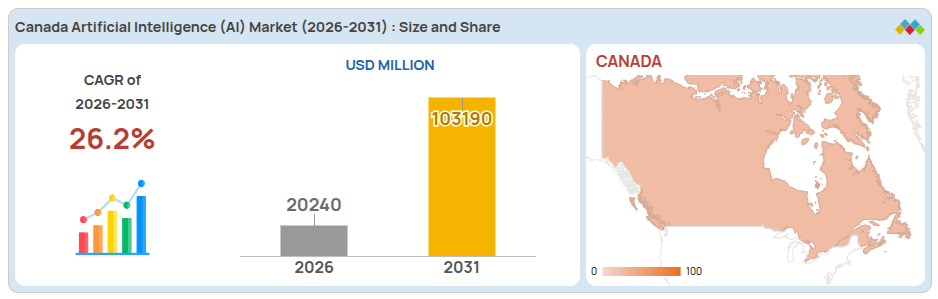
Markets and Markets - Canada Artificial Intelligence (AI) Market (2026-2031)
The Invisible Trap: The U.S. CLOUD Act and Industrial Data
Technological dependence on centralized, foreign-owned infrastructure introduces severe data exfiltration risks for small and medium-sized businesses (SMBs) and large prime contractors alike—particularly within highly regulated, high-security sectors like aerospace and defence.

The Impact of American Extraterritoriality
> The Critical Node: The United States CLOUD Act (Clarifying Lawful Overseas Use of Data Act) grants federal authorities the legal mandate to compel U.S.-based cloud service providers to surrender data stored on their servers, completely overriding the physical location of the data center, even if it resides entirely on Canadian soil.
The Loss of Control in Public Clouds
For a Canadian enterprise, this means that sensitive industrial schematics, Controlled Goods Program (CGP) data, or proprietary financial logs lose their sovereign protection the moment they are routed through non-insulated, public Large Language Models (LLMs). This operational reality is driving a strategic market pivot away from centralized public clouds and toward secure, local edge infrastructures.
The Canadian Response: Local-First Architecture and Compliance by Design
Faced with a mounting "compliance wall" driven by rigorous regional and federal regulatory frameworks—such as Quebec's Law 25, Bill S-211 on forced labour, and Bill C-26 on cyber resilience—the market requires a fundamental paradigm shift. The definitive solution lies in Local-First architectures.
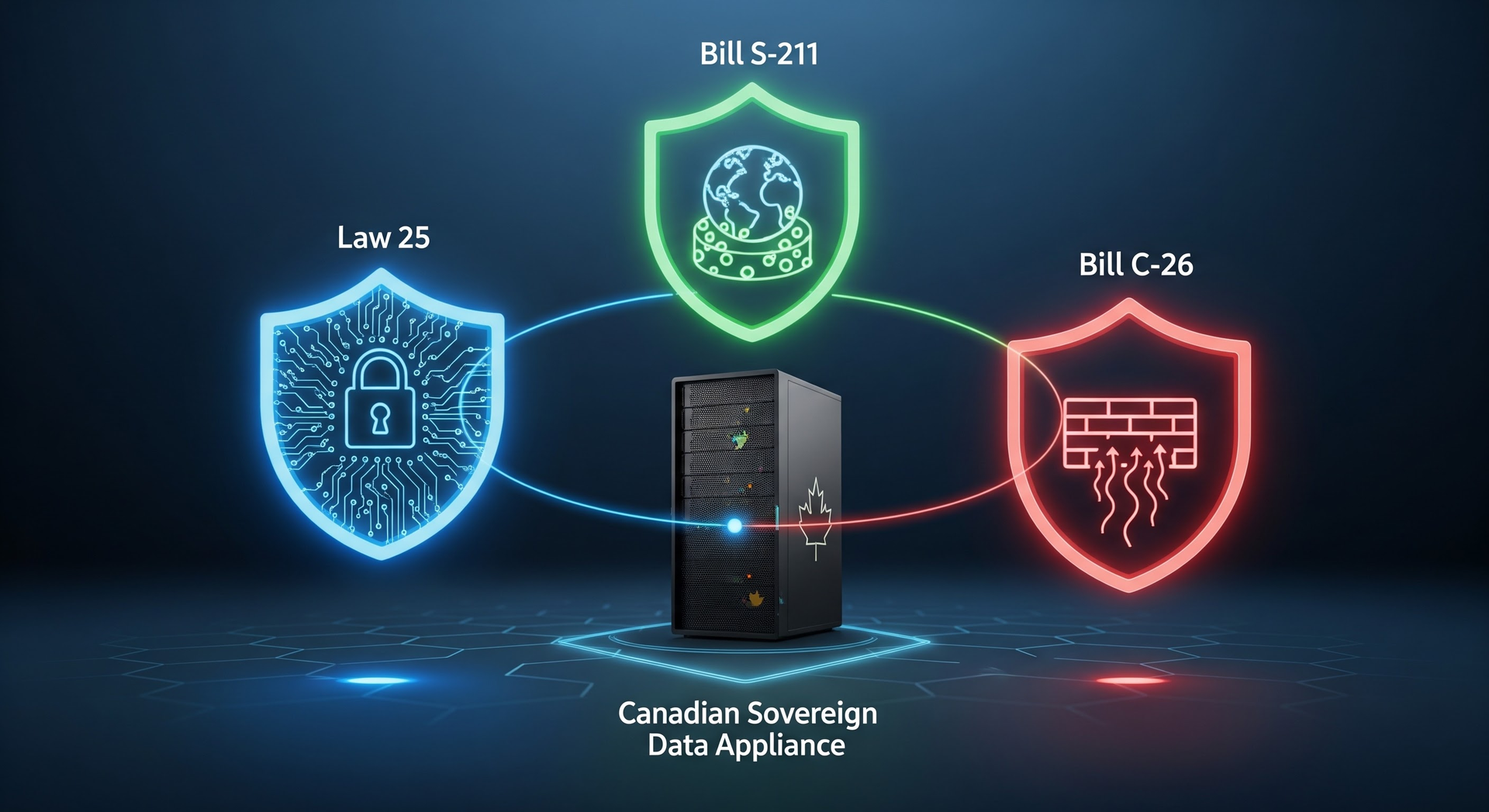
Cloisonnement as a Security Boundary
A sovereign, local appliance deployed physically on-site or within a private, fully insulated Canadian cloud environment unlocks the full analytical power of state-of-the-art reasoning models without ever allowing corporate data assets to leave the operational perimeter.
- Zero Exfiltration: AI processing queries are intercepted, contained, and executed locally leveraging dedicated corporate compute resources.
- Native Compliance: Instantaneous alignment with stringent data governance protocols, effectively converting regulatory overhead into a premium commercial advantage.

The future of enterprise intelligence does not belong to exporting vast corporate knowledge bases to external third-party clouds; it belongs to anchoring AI models locally, precisely where the data is born.
| Architecture Element | Traditional Public Cloud ERP Architecture | Okiff Sovereign Local-First Architecture |
|---|---|---|
| Data Residency | Hosted on foreign-owned multi-tenant infrastructure, subject to jurisdictional risk. | Grounded entirely on-premise or within localized, private Canadian servers. |
| Legal Framework Exposure | Vulnerable to extraterritorial data seizure under the U.S. CLOUD Act and FISA Sec 702. | Insulated against foreign access; designed for absolute compliance with Quebec's Law 25 and Bill C-26. |
| Data Flow Path | Transits via external public networks to foreign servers for processing. | Processed locally via a strict "Data Wall" pipeline; data never exits the secure boundary. |
| AI Knowledge State | Reactive (traditional RAG pipeline searching external database nodes). | Proactive (Cache-Augmented Generation pre-loaded directly into local GPU KV cache). |
| Processing Latency | Variable transmission lag spanning between 100ms and 2,000ms+. | Deterministic, high-throughput execution under 10ms. |
| Operational Control | High technical complexity with fragmented SaaS sprawl and orphaned account risks. | Low operational complexity managed via system-kernel Triple Federation (Identity, Data, Policy). |
Secure Your Enterprise Sovereignty Today
Don't let your sensitive business intelligence and industrial data sit vulnerable in a foreign public cloud. Empower your teams with advanced automation while maintaining 100% control over your regulatory perimeter.