
In June, a fire tore through a one million square foot Medline distribution warehouse in Tracy, California, in an industrial park that also holds facilities for Amazon, Home Depot, and FedEx. Officials described it as one of the largest warehouse fires of its kind, with one calling the wreckage a skyscraper laying on its side. Employees got out safely, and the blaze jumped the street into a neighboring FedEx building before crews stopped it there. The Tracy Fire Department later said the warehouse's own sprinkler system never activated, despite having passed inspection months earlier. A week later, a cold storage warehouse in Boyle Heights, Los Angeles, caught fire after a lithium ion battery, likely from a forklift, ignited inside. The roof's solar panels complicated firefighting, hydrogen fluoride gas from the burning battery forced a shelter in place order days after the fire started, and the city declared a state of emergency. Real estate trade press has started calling this a pattern rather than a string of separate incidents, framing today's warehouses as larger, colder, and harder to defend once something goes wrong.
Bigger, Colder, and Slower to Notice
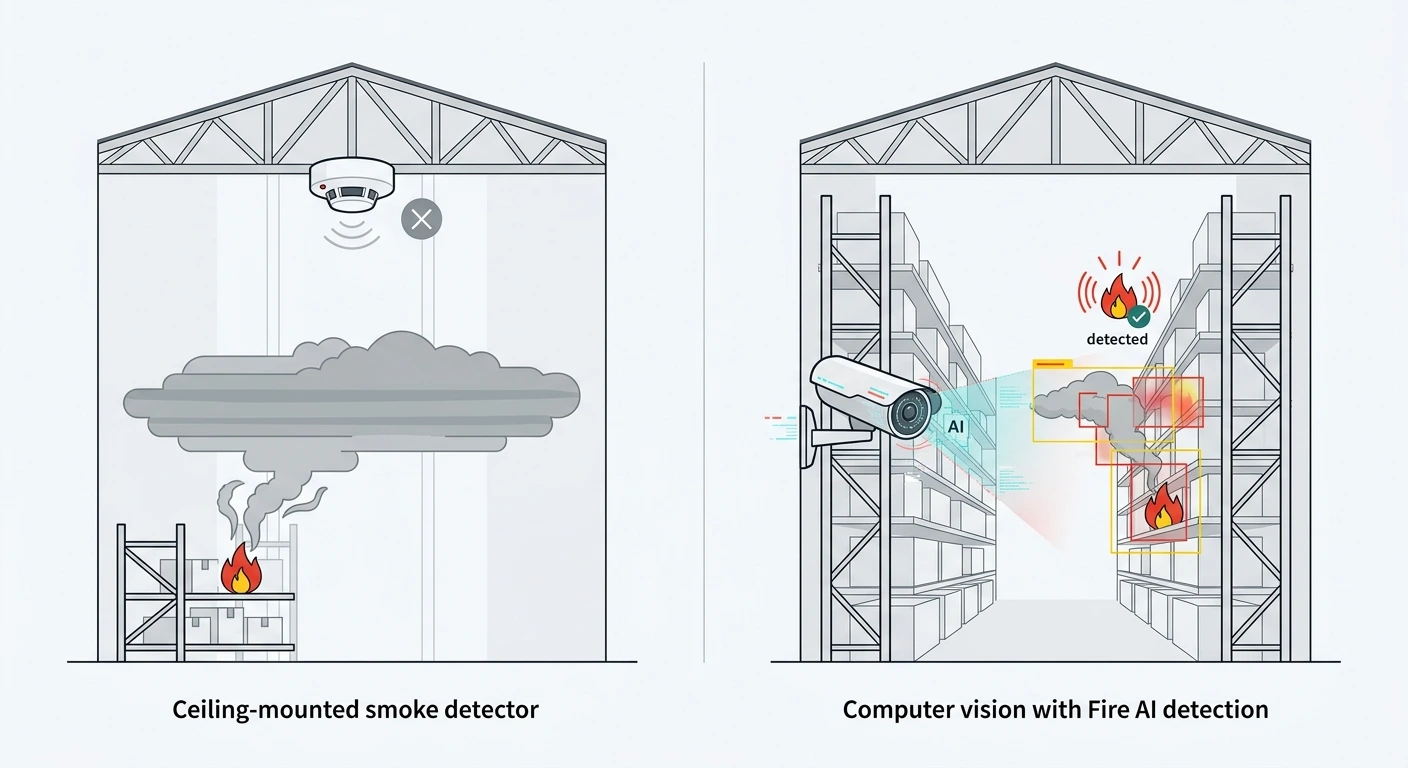
Larger and colder are the two words that matter most for how these fires actually get detected. A standard ceiling mounted smoke detector works by waiting. It sits at the top of a room and does nothing until enough smoke particles physically drift up and reach it. In a normal office or a house, that happens fast enough. In a warehouse with a forty foot ceiling, it often doesn't happen fast at all, because of something called thermal stratification: hot smoke rises, cools as it spreads, and can hang in a stable layer well below the ceiling instead of continuing up to where the sensor is waiting. High bay racking makes it worse. A fire that starts three shelves deep in a storage aisle can be boxed in on three sides and above by product, so smoke spreads sideways through the rack structure long before it ever reaches open ceiling space. Cold storage adds another problem on top of that, since the temperature swings and humidity that come with refrigerated environments are exactly the conditions that make standard photoelectric sensors unreliable.
The Minutes the Fire Code Is Trying to Save
None of this is a fringe concern. NFPA 72, the code that governs fire alarm design in the US, has entire sections dealing with exactly this: reduced detector spacing as ceiling height increases, guidance pushing large or tall spaces toward beam detectors or aspirating systems instead of simple point detectors, and separate provisions for the high airflow, dust, and obstruction problems that show up in industrial buildings. The gap those rules are trying to close is measured in minutes, and minutes are the one thing a real fire doesn't give back. Underwriters Laboratories' fire safety research institute has clocked the time from ignition to flashover in a modern, furnished room at around three minutes and forty seconds. In a space where detection is delayed by even a couple of those minutes, most of the window in which a fire is still small enough to fight has already closed before anyone, or anything, knows it exists.
Watching the Space Instead of Waiting for the Air to Change
This is the specific gap that camera based fire detection was built to close, and it's worth being precise about what that actually means. Video fire detection doesn't wait for smoke to travel anywhere. A camera watching a storage aisle or a loading dock is already looking at the space where a fire would start, so it can flag the visual signature of flame or rising smoke the moment it appears, regardless of ceiling height or airflow. NFPA 72 has recognized video based smoke and flame detection as a listed technology since 2007, and when the hardware and software are listed for that purpose and the coverage is engineered and signed off by the local authority having jurisdiction, it can serve as a building's primary detection system in its own right, not just a supplement bolted onto existing sensors. In practice, most facilities still run it alongside conventional point detectors, since that's the easier path for a retrofit, and it earns its keep filling in the high bay, high airflow, and outdoor zones where spot detectors are slow or can't be installed at all. The same visual approach also helps with a separate, more everyday problem: nuisance alarms. Forklift exhaust, welding sparks, steam, and sunlight glare all trip conventional detectors more often than most facility managers would like, and a system that can actually see the difference between smoke and a reflection cuts down on the false alarms that erode trust in the whole system over time.
Not a Replacement, a Second Set of Eyes
None of this makes ceiling detectors obsolete, and any facility manager who suggests otherwise probably hasn't had to deal with an authority having jurisdiction. What it does mean is that in the buildings going up right now, the ones with soaring ceilings, dense racking, and the added complication of lithium ion batteries charging on the floor, watching the space itself has become just as important as waiting for the air to change. We've written more about how AI based fire and smoke detection fits alongside a facility's existing systems on our workplace safety page, for anyone weighing where it belongs in their own building.